Martinic Scanner Vibrato: The Tonewheel Organ's Chorus/Vibrato for Any Track
Martinic Scanner Vibrato is a $49 effect plugin ($24.50 in Martinic's Black Friday sale until December 5, 2026) that recreates the scanner chorus/vibrato of the classic tonewheel organ, for Windows and macOS in AAX, AU, CLAP, VST2 and VST3 formats. It keeps the original's six V-1 to C-3 settings and adds variable rate, depth, mix, stereo width and tempo sync. The free demo runs for up to 30 days.
The scanner-vibrato is the swirl that makes a tonewheel organ sound alive before the rotary speaker even starts. It's built into most organ plugins, but not into your guitar, electric piano or synth pad. This plugin puts that effect on any track.
Quick facts
- Developer: Martinic (Schagen, The Netherlands); Scanner Vibrato was its first commercial plugin, in 2016
- Version: 1.4.4, released May 15, 2026
- Effect: ACE-modeled tonewheel organ scanner chorus/vibrato, stereo
- Formats: AAX, AU (Mac), CLAP, VST2, VST3
- Platforms: Windows 7 or newer (x64/x86), Windows 11 on Arm (Arm64EC), macOS 10.9 or newer on Intel and Apple Silicon
- Installer size: 10.1 MB (Windows), 47 MB (Mac)
- Presets: 16, from classic chorus/vibrato to rotary-like effects
- Price: $49 lifetime license, $24.50 until December 5, 2026; One Year License $16
- Copy protection: a license key file; no dongle and no online activation
- Demo: up to 30 days for testing and unpublished work; the interface turns red once a minute and white noise is added
- What we checked: the US checkout price ($49 list, 50% off to $24.50) and the $16 One Year License on Martinic's FastSpring store, the 10.1 MB Windows installer for version 1.4.4, and the user manual, changelog and demo terms on martinic.com, on November 19, 2026. We didn't run the demo on a mix.
Download Free TrialBuy Now
Overview
The original scanner-vibrato, developed in the 1940s, was an electromechanical device: an analog delay line read by a rotating "scanner" driven by the organ's motor. Its speed was fixed at about 6.9 Hz, and it offered three vibrato and three chorus depths. That rotating scan creates phase-shifting patterns that a simple LFO-based chorus doesn't quite reproduce.
Martinic Scanner Vibrato models that circuit with Martinic's ACE (Advanced Circuitry Emulation) and keeps the familiar controls: an on/off rocker and the big V-1/C-1 to V-3/C-3 selector. Around them it adds what the original couldn't do: two rates from 0 to 15 Hz, a Link switch, Depth, Width and Mix knobs, tempo sync and an output volume. A Settings view lists every parameter, including a Model button that switches between the original v1.0.0 model and the remodeled v1.1.0 one (the default).
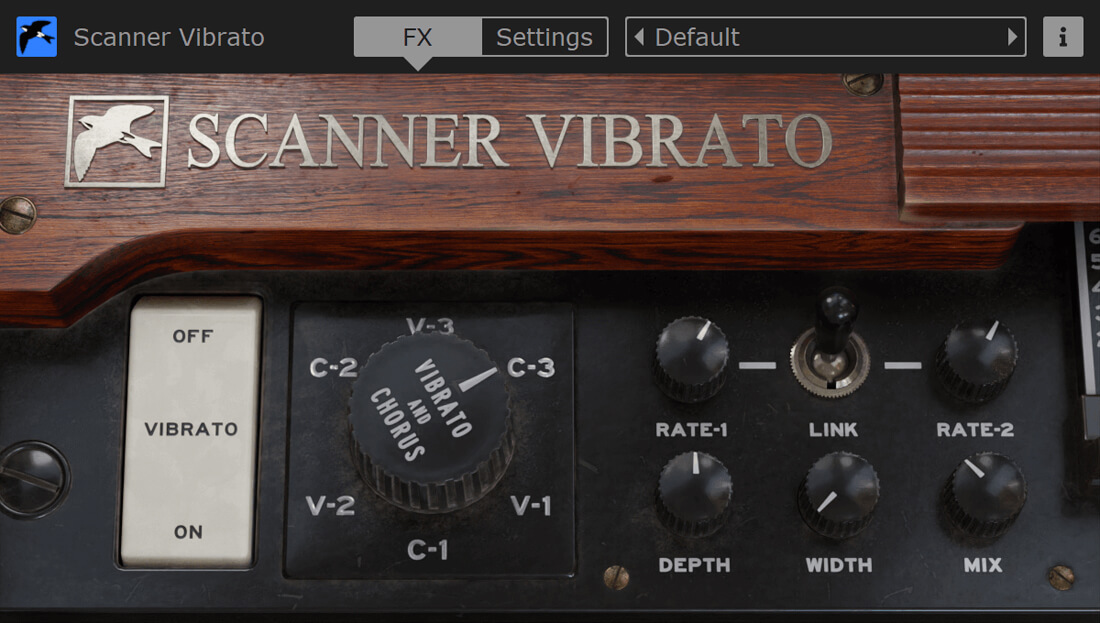
The FX view: the Off/Vibrato/On rocker, the V-1 to C-3 selector, Rate-1 and Rate-2 with the Link switch between them, and the Depth, Width and Mix knobs.
Features
The six original settings
Martinic Scanner Vibrato's rotary selector picks vibrato (pitch wobble only) or chorus (vibrato mixed with the dry signal) at three depths, light to heavy: V-1, C-1, V-2, C-2, V-3 and C-3, as on the organ. Load it, pick C-3 and you have the classic thick organ chorus straight away.
Variable rate and depth
Martinic Scanner Vibrato starts at the original's 6.9 Hz, but its Rate knobs go from stationary (0 Hz) up to 15 Hz, and Depth scales the effect from subtle to deliberately extreme. Sync locks the rate to your DAW's tempo in note values. A Mix knob (35% by default in chorus mode) sets the dry/wet balance; in vibrato modes the effect is fully wet.
Stereo width the organ never had
Martinic Scanner Vibrato turns the mono original into a stereo effect. With Link off, Rate-1 drives the left channel and Rate-2 the right, and Width goes from mono to full stereo; with Link on, both sides share Rate-1 and Width changes the phase between them. Slightly different left and right rates give a slow, rotary-like movement.
Click-free switching and presets
Martinic Scanner Vibrato's on/off rocker keeps feeding audio into the effect while it's off, so you can switch it in and out mid-song without pops or clicks, unlike bypassing it in the DAW. Sixteen presets cover classic chorus/vibrato through rotary-like sounds.
Benefits
- An organ effect for everything else: guitars, electric pianos, synth pads and vocals get the same vintage movement.
- Fast: the six original positions give a good result in one click, and the extra knobs are there when you want them.
- Light: a 10 MB installer for one focused effect.
- Cheap to own: $49, or $24.50 in the sale, for a lifetime license with no activation.
Real-World Uses
- Organ plugins without a good chorus: put it before a rotary speaker plugin for a more authentic tonewheel chain.
- Guitar: C-1 or C-2 at a low mix for a 60s-style chorus, or a fast V-3 for the Leslie-ish warble of psychedelic records.
- Pads and reverb returns: producer Jam El Mar suggests it on pads or on the return channels of reverbs or echoes.
- Electric piano: wide stereo with different left and right rates for a slow, shimmering Rhodes or Wurlitzer.
Who It's For, and Who Should Skip It
It's for producers and organists who want the authentic tonewheel chorus/vibrato as a separate effect, and guitarists and keyboard players after a vintage modulation color that's different from a pedal-style chorus.
Skip it if you want a rotary speaker (Leslie) simulation: this is the organ's built-in chorus/vibrato, not the speaker cabinet. If your organ plugin already has a good scanner vibrato and you don't need it on other tracks, it adds little.
Usage Guide
- Download the installer from the downloads page: Windows x64/x86, Windows Arm64EC or the macOS DMG.
- Run it and choose the plugin formats; Windows users can pick a GUI scale.
- Insert Scanner Vibrato on a track or effect return in your DAW. Without a license it runs as the demo: the interface turns red once a minute and white noise is added.
- After buying, put the license key file next to the installer and run it again to install the license.
- Pick a V or C position with the selector, then fine-tune Rate, Depth, Width and Mix. Hold Shift while dragging a rate knob to move both sides together.
- Turn on Sync in the Settings view to lock the rate to your tempo, and save the result as a preset.
Before you buy
- The sale ends December 5, 2026. Martinic's Black Friday sale cuts all plugins by 50% from November 19 to December 5, 2026; then the price returns to $49.
- Retro Pack 2. Scanner Vibrato is also part of Retro Pack 2 with the Elka Panther organ, Pianet T, Lem Echo Music, Colorsound Tremolo and Kee Bass, worth a look if you want the organ too.
- Free updates through 1.x.x.
- Refunds go through FastSpring, Martinic's payment provider; the 30-day demo is the better way to decide.
Where it falls short
- One job only. It does chorus/vibrato; there's no rotary speaker, drive or tone stack.
- Not much independent coverage. The only KVR user review dates from 2018 and version 1.0.1, before the remodeled engine, so the demo is the best guide to the current version.
What Users Say
KVR Audio users (5 out of 5 from 1 review)
Stohgs (v1.0.1, Windows, March 30, 2018): "I personally use this VST Effect often and for various genre styles that it still surprises me how well it holds inside the mixes. Solid structure and classic vibe to it." The same reviewer adds: "For what it is, I'd recommend it." Stohgs also made one of the audio demos on Martinic's site.
Sound On Sound (news on the remodeled version, September 2022)
Sound On Sound's report on the ACE update described the Depth range this way: "0% providing a small amount of chorus or vibrato, and 100% sounding like the emulated electronic contacts need cleaning!" It's a news item, not a review, but it confirms the remodeled engine, the Model switch and the separate left and right rates.
Musicians quoted by Martinic
- Jam El Mar (Jam & Spoon): "Scanner Vibrato is fantastic to make things become alive in the mix. It's perfect on pads or even on the return channels of reverbs or echo."
- Joop van der Linden: "Scanner Vibrato will add depth or movement to any sound that's in need of some livening up. I love to use it on a synth pad, guitar bus, or even vocals for some extra je-ne-sais-quoi."
- Robin Miller: "Finally got that fast intense Brian Auger vibrato sound I love on Brian Auger recordings."
The pattern: users like how quickly it adds movement and how well it sits in a mix, on far more than organ. Independent reviews are scarce, and none covers the current version in depth.
Comparisons
Scanner Vibrato vs a rotary speaker plugin
A rotary speaker plugin simulates the spinning horn and drum of a Leslie cabinet, with its Doppler effect and amp drive. Scanner Vibrato is the organ's own built-in chorus/vibrato that comes before the speaker. On a classic organ sound you'd often use both, in that order.
Scanner Vibrato vs a standard chorus plugin
A typical chorus modulates a short delay with an LFO. The scanner design gives a more complex, slightly uneven phase pattern with a vintage character, which is why it stands out on guitars and keys. For a clean, modern chorus, a standard plugin is the simpler choice.
Editions and Pricing
| Option | Regular price | Price to Dec 5, 2026 | What you get |
|---|
| Full Version | $49 | $24.50 | Lifetime license, updates through 1.x.x |
| One Year License | $16 | $16 | Full plugin for 12 months, no auto-renewal |
| Retro Pack 2 | $239 | $119.50 | Scanner Vibrato plus five other Martinic instruments and effects |
Both Scanner Vibrato licenses are on the order page that the Buy Now button opens.
FAQs
Is Martinic Scanner Vibrato a Leslie simulator?
No. Martinic Scanner Vibrato models the tonewheel organ's built-in chorus/vibrato circuit, not the rotary speaker. Its presets include rotary-like sounds, but for a real Leslie effect you'd add a rotary speaker plugin after it.
How long does the Martinic Scanner Vibrato demo last?
Martinic Scanner Vibrato can be tried free for up to 30 days for testing and unpublished work. During the demo the interface turns red once a minute and white noise is added to the output.
Does Martinic Scanner Vibrato work on a mono track?
Martinic Scanner Vibrato is a stereo effect that processes both channels; on a mono source it creates its stereo spread from the separate left and right rates and the Width control.
Does Martinic Scanner Vibrato need online activation?
No. Martinic Scanner Vibrato uses a license key file from FastSpring, with no dongle and no online activation. On a Mac you can also copy the key file into the plugin's Application Support folder by hand.
Can I get the old Scanner Vibrato sound back?
Yes. Martinic Scanner Vibrato's Model button in the Settings view switches between the original v1.0.0 model and the remodeled v1.1.0 one, and some presets use each.
System Requirements
- Windows 7 or newer, x64 or x86 (AAX, CLAP, VST2, VST3)
- Windows 11 on Arm via the Arm64EC installer (CLAP, VST2, VST3)
- macOS 10.9 Mavericks or newer, Intel or Apple Silicon (AAX, AU, CLAP, VST2, VST3)
- A DAW or plugin host; a sample rate of 44.1 kHz or higher is recommended
Conclusion
Martinic Scanner Vibrato is worth it for anyone who wants the tonewheel organ's chorus/vibrato as a standalone effect: at $24.50 until December 5, 2026 it's an easy buy, and $49 is still fair for a focused, well-maintained plugin. The reason to buy it is that classic swirl on guitars, keys and pads with stereo width the original never had. The reason to skip it is if you were really after a rotary speaker, which it isn't. The 30-day demo gives plenty of time to decide.
Download Free TrialBuy Now