Martinic AX73: An 80s Analog Polysynth Rebuilt as a Two-Layer Soft Synth
Martinic AX73 is a $149 analog synthesizer plugin ($74.50 in Martinic's Black Friday sale until December 5, 2026) for Windows and macOS in AAX, AU, CLAP, VST2 and VST3 formats. It models the 1986 Akai AX73 with Martinic's circuit-modeling engine, then adds a second layer, four times the polyphony, eight envelopes, eight LFOs, two arpeggiators and an eight-unit effects rack. A free demo is available.
If you like the warm, slightly lo-fi sound of mid-80s analog polysynths but don't want to chase a 40-year-old keyboard that stored its patches on cassette tape, this is the plugin aimed at you. It sounds like an Akai, but it programs like a modern synth.
Quick facts
- Developer: Martinic (Schagen, The Netherlands)
- Version: 1.4.4, released May 15, 2026
- Modeled on: Akai AX73 (1986), with features borrowed from the AX60 and AX80
- Formats: AAX, AU (Mac), CLAP, VST2, VST3; no standalone app
- Platforms: Windows 7 or newer (x64/x86), Windows 11 on Arm (Arm64EC), macOS 10.9 or newer on Intel and Apple Silicon
- Installer size: 11.7 MB (Windows), 53 MB (Mac)
- Presets: 600+ factory presets, plus the AX73 Legacy and Doctor Mix collections free with a license
- Price: $149 for a lifetime license, $74.50 until December 5, 2026; a non-renewing One Year License is $49
- Copy protection: a license key file; no dongle and no online activation
- Demo: free, fully featured, but adds white noise to the output; for testing and unpublished work only
- What we checked: the US checkout price ($149 list, 50% off to $74.50) and the $49 One Year License on Martinic's FastSpring store, the 11.7 MB Windows installer for version 1.4.4, and the changelog and specifications on martinic.com, on November 19, 2026. We didn't play the demo against a hardware AX73.
Download Free TrialBuy Now
Overview
The original Akai AX73 was a six-voice analog synth built around the CEM3394 "synth on a chip". It had one VCO per voice, a resonant low-pass filter, a chorus and, notoriously, cassette tape for patch storage. It was overshadowed by Roland's Juno series and is now mostly a collector's item.
Martinic's version keeps the character and the look but changes almost everything else. Each patch holds two complete synths (Upper and Lower layers) that you can stack for thick sounds or split across the keyboard to play two patches at once. Polyphony goes up to 24 voices, and Martinic borrowed extra chorus settings and the arpeggiator from the AX60, and a second VCO and sub oscillator from the AX80. The sound comes from Martinic's ACE (Advanced Circuitry Emulation) modeling, not samples.
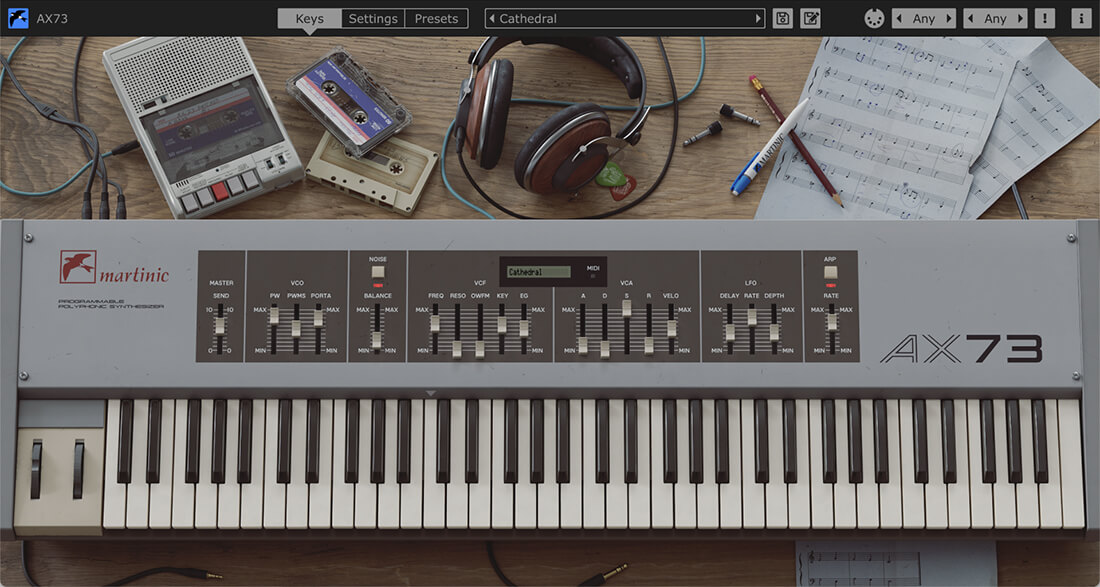
The Keys view: the AX73's slider panel (VCO, VCF, VCA, LFO, arpeggiator) on a desk with a cassette recorder, playing the "Cathedral" preset.
Features
Two layers, split or stacked
Martinic AX73 gives every patch an Upper and a Lower layer. Stack them to combine, say, a plucky attack from one with a slow pad from the other, or split them so a bass plays below the split point and a lead above. MIDI Split mode lets two MIDI channels drive the layers separately, and the mod wheel can be routed to either layer or both.
Oscillators and filter beyond the original
Martinic AX73 has two VCOs per layer (four when stacked), each with a sub oscillator and five waveshapes (saw, triangle, square, saw plus triangle, sine) with assignable pulse width, plus a pink noise generator. The filter switches between low-pass, band-pass and high-pass at 6, 12 or 24 dB per octave, self-oscillates, and keeps the AX73's OWFM, which modulates the cutoff with the oscillator frequency for gritty, FM-like tones.
Eight envelopes and eight LFOs
Martinic AX73 gives each layer four DADSR envelopes (one fixed to the amplifier, three assignable) and four LFOs, so a stacked patch has eight of each. LFOs offer saw, triangle, square, random, parabola and sine shapes, a step function that works like sample-and-hold, tempo sync and several retrigger modes. Destinations include pitch, cutoff, resonance, pulse width, OWFM, level and pan.
An arpeggiator per layer
Martinic AX73 has a separate arpeggiator on each layer, with 11 modes including the unusual Shuffle, Improv and Chord, octave range, gate length, hold and DAW tempo sync. Two arpeggiators running different patterns on a split keyboard is a quick way to build a moving 80s-style backing.
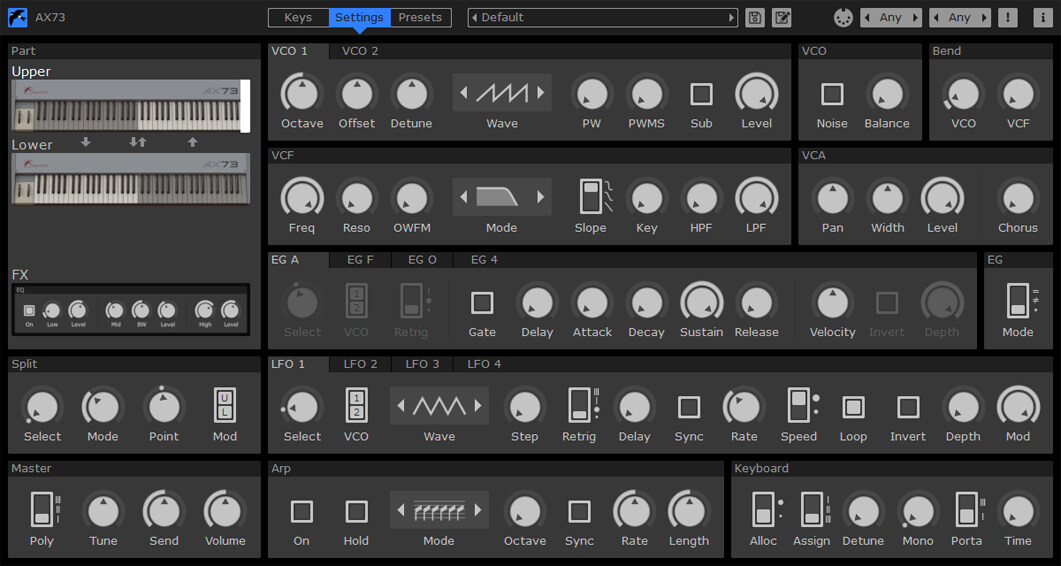
The Settings view: Upper and Lower parts on the left, then tabs for VCO 1/2, the filter, four envelopes, four LFOs, the arpeggiator, keyboard modes and master controls.
Built-in effects rack
Martinic AX73 runs every patch through the original AX73-style chorus (four modes) and then an eight-unit effects section: compressor, chorus, flanger, phaser, delay with ping-pong, reverb, three-band EQ and distortion, each with its own mix control and in any order you like. The same effects are sold separately as the AXFX plugin for use on other tracks.
600+ presets and a proper preset manager
Martinic AX73 ships with more than 600 factory presets from sound designers including Nori Ubukata (who programmed sounds for the Yamaha DX7), Summa and Synth Guru Wiffen, plus the AX73 Legacy collection of the original hardware's patches and a Doctor Mix collection. The preset manager sorts sounds into collections you can export and share, with tags for quick browsing. Further preset collections cost $25 each.
Benefits
- A different flavor from the usual Juno and Prophet clones: reviewers keep describing it as a synth with its own character rather than another copy of a famous instrument.
- Easy to program: one control per function, no menu diving, and a flat settings page where everything is visible.
- Light on the system: an 11.7 MB installer and no sample library to download.
- No activation hassles: a key file you keep, so it works offline and on a studio computer that never goes online.
Real-World Uses
- Synthwave and nu-disco: detuned unison leads, chorused pads and arpeggiated basses that sit in an 80s mix without extra processing.
- Layered pads for film and games: a slow, filtered pad on one layer and a bright bell attack on the other, saved as one preset.
- Live keyboard splits: bass on the left hand, organ or brass on the right, from one plugin instance.
- Sound design: self-oscillating filter, OWFM and random LFO steps for effects and textures.
Who It's For, and Who Should Skip It
It's for producers who want a characterful analog-style polysynth for 80s-flavored music, players who like hands-on programming, and anyone who'd rather own a lifetime license than rent a synth.
Skip it if you need MPE or aftertouch-driven expression (the Sound On Sound review found neither), a standalone app to play live without a DAW, or audio input processing like the original hardware had. If you want an exact clone of a famous synth such as a Juno-60, a dedicated emulation of that model fits better.
Usage Guide
- Download the installer for your system from the downloads page: Windows x64/x86, Windows Arm64EC or the macOS DMG.
- Run it and pick the plugin formats you need (AAX, CLAP, VST2, VST3, plus AU on Mac). Windows users can choose a GUI scale during installation.
- Rescan plugins in your DAW and load Martinic AX73 on an instrument track. Without a license it runs as the demo, with white noise in the output.
- After buying, you receive a license key file by email. Put it next to the installer and run the installer again, and it finds and installs the license.
- Browse presets with the arrow buttons or the Presets view, then switch to Settings to edit both layers.
- Save your own sounds into a user collection; you can export it to share or back it up.
Before you buy
- Time the sale. Martinic's Black Friday sale (50% off all plugins) runs from November 19 to December 5, 2026. After that, the lifetime license goes back to $149.
- Free updates stop at version 2. A license includes free upgrades through version 1.x.x only.
- Consider the AX Bundle. If you also want the AXFX rack and AX Chorus, the AX Bundle includes them and eight preset collections for $359 ($179.50 in the sale).
- Refunds go through FastSpring, Martinic's payment provider, so try the demo first.
Where it falls short
- The interface is plain. The Keys page shows only a few of the upper layer's controls, and the Settings page is flat grey. Sound On Sound compared it to the Atari ST era.
- No aftertouch or MPE. Sound On Sound's review (version 1.0) found neither, and the changelog since adds MIDI learn for channel aftertouch but no aftertouch modulation or MPE.
- Uneven voice split between layers. The Upper and Lower layers share voices only in the original's 3:0, 2:1, 1:2 and 0:3 ratios.
- Not a forensic clone. Played next to a real Akai VX90, the oscillators were close but filter sweeps sounded slightly different.
- Some find it polite. One KVR user found the sounds "not extremely in your face" before adding compression and effects.
What Users Say
Sound On Sound (Gordon Reid, March 2022)
Gordon Reid compared version 1.0 with his own Akai VX90, the AX73's rack version. Several of his complaints have since been fixed: AAX support arrived in version 1.3.0, VST3 in 1.4.0, and the Windows installer now offers GUI scaling.
- Verdict: "Despite its rather bland appearance, it's a surprisingly competent soft synth and there's much here to enjoy. If you're looking for something a little leftfield (or even if you're not) it's certainly worth trying."
- On programming: "it's so difficult to programme great sounds on the original AX73 and so simple on the soft synth that I found the comparison almost pointless."
- On sound quality: "the sound of the AX73 remains commendably lacking in artefacts."
- On the GUI: "if you have a hankerin' for a slick, resizable, rendered GUI, this isn't the soft synth for you."
- On its shortcomings: "it doesn't respond to aftertouch or MPE, and MIDI Learn suffers from the common limitation that any given CC can affect only one parameter at a time."
KVR Audio users (4.75 out of 5 from 4 reviews)
- Owl Cave Dreams (v1.0, Windows, February 2022): "I owned an actual AX73 for 30 years. This sounds like the real thing. This is a fantastic emulation with the option to go beyond the original, adding new features."
- Megawattt (v1.1.1, Windows, June 2022): "a lot of the sounds have an inspirational vibe to them that almost forces me to want to make music, also the library system is very good"
- zandoka (v1.01.1, Mac, October 2021): "Is it a mind-blowing, epic plug-in? No. Is it a fairly priced, great addition to the plug-ins I will use for my music? Hell yeah." The same reviewer finds "the sounds not extremely in your face (not loud, phat, thick, or whatever you want to call it) but nothing that can't be solved with some compression and effects."
- noahrbc (v1.4.2, Mac, January 2025): "Really beautiful modern version of the titular 90s synth. Great new addition to the arsenal."
Musicians quoted by Martinic
- Jordan Rudess: "Not only did Martinic allow me to discover a cool hardware synthesizer that somehow escaped my radar but their AX73 software recreation is really awesome and will now be one of my go to instruments!"
- Doctor Mix: "The Martinic AX73 is very special. It sounds like the original unit... but on steroids! I love it."
- Peter Voorthuijsen: "I've spent a lot of hours browsing through the presets and I found many amazing ones that I just had to keep playing melodies with."
- NeonDanTV: "Even 5 minutes in I can definitely hear totally usable sounds straight away."
The pattern: players praise the sound, the presets and how easy it is to program, and two KVR reviewers mention fast replies from Martinic's support. The criticisms are the dated, plain interface, the lack of aftertouch and MPE, and a tone some find a little polite until it's processed.
Comparisons
Martinic AX73 vs the original Akai AX73
The hardware had six voices, one VCO per voice, a single layer and tape storage. The plugin has up to 24 voices, two VCOs plus subs per layer, two layers, eight envelopes and LFOs, two arpeggiators and an effects rack. Sound On Sound's reviewer called the link to the original "at best tenuous" because the plugin does so much more.
Lifetime license vs One Year License
The lifetime license ($149, $74.50 in the sale) includes updates through version 1.x.x. The One Year License ($49, not discounted in the sale) gives the full plugin for a year and doesn't renew automatically. During the sale, the lifetime license costs only $25.50 more, which makes it the obvious pick.
Editions and Pricing
| Option | Regular price | Price to Dec 5, 2026 | What you get |
|---|
| Full Version | $149 | $74.50 | Lifetime license, updates through 1.x.x, Legacy and Doctor Mix collections |
| One Year License | $49 | $49 | Full plugin for 12 months, no auto-renewal |
| AX Bundle | $359 | $179.50 | AX73, AXFX, AX Chorus and eight preset collections |
Both AX73 licenses are on the same order page; the Buy Now button takes you there.
FAQs
Does Martinic AX73 need an iLok or online activation?
No. Martinic AX73 is licensed with a key file that FastSpring generates when you buy, with no dongle and no online activation. Keep the file safe, since you'll need it to reinstall.
Does Martinic AX73 run natively on Apple Silicon and Windows on Arm?
Yes. Martinic AX73's Mac installer covers Intel and Apple Silicon natively, and there's a separate Arm64EC installer for Windows 11 on Arm (CLAP, VST2 and VST3).
Does Martinic AX73 work in Pro Tools and Logic Pro?
Yes. Martinic AX73 comes as AAX for Pro Tools (since version 1.3.0) and AU for Logic Pro and GarageBand, as well as VST2, VST3 and CLAP for most other DAWs.
Is there a standalone version of Martinic AX73?
No. Martinic AX73 is a plugin only, so you need a DAW or plugin host to play it.
What happens when the One Year License ends?
Martinic AX73's One Year License simply expires after 12 months; you're not charged again. You can buy another year or the lifetime Full Version to keep using it.
Can I resize the Martinic AX73 window?
Partly. On Windows you choose a GUI scale (100% to 200%) in the installer, and macOS supports Retina displays and a 200% option in the installer. There's no drag-to-resize corner.
How do I get a refund for Martinic AX73?
Martinic AX73 orders are handled by FastSpring, and refund requests go through FastSpring. Martinic asks you to contact its support first if the problem is installing or using the plugin.
System Requirements
- Windows 7 or newer, x64 or x86 (AAX, CLAP, VST2, VST3)
- Windows 11 on Arm via the Arm64EC installer (CLAP, VST2, VST3)
- macOS 10.9 Mavericks or newer, Intel or Apple Silicon (AAX, AU, CLAP, VST2, VST3)
- A DAW or plugin host; a sample rate of 44.1 kHz or higher is recommended
Conclusion
Martinic AX73 is worth buying if you want an analog-style polysynth with its own 80s character, deep but simple programming and a big preset library, and at $74.50 until December 5, 2026 it's a bargain; even at $149 it's fairly priced. The one reason to buy it is the two-layer engine, which turns an obscure Akai into a flexible modern synth. The main reason to pass is the plain interface and the lack of aftertouch and MPE, so play the demo for a session first.
Download Free TrialBuy Now