Martinic Pianet T: The 70s Suction-Pad Electric Piano, Modeled for Your DAW
Martinic Pianet T is a $99 electric piano plugin ($49.50 in Martinic's Black Friday sale until December 5, 2026) for Windows and macOS in AAX, AU, CLAP, VST2 and VST3 formats. It models the Hohner Pianet T, an electro-mechanical piano whose reeds are plucked by sticky rubber pads, and adds an "Unplugged" acoustic model, a harmonic mixer, vibrato, tremolo, chorus and a tube amp. A free demo is available.
The Pianet T sits somewhere between a Wurlitzer and a Rhodes: percussive, a little bell-like, and quieter than either. This plugin gives you that sound without tracking down and maintaining a 50-year-old keyboard.
Quick facts
- Developer: Martinic (Schagen, The Netherlands)
- Version: 1.0.4, released May 15, 2026 (first released May 23, 2024)
- Modeled on: Hohner Pianet T (introduced 1977), 60 keys, F to E
- Sound engine: Martinic's ACE pickup model plus a physically modeled Unplugged model; no samples
- Formats: AAX, AU (Mac), CLAP, VST2, VST3; no standalone app
- Platforms: Windows 7 or newer (x64/x86), Windows 11 on Arm (Arm64EC), macOS 10.9 or newer on Intel and Apple Silicon
- Installer size: 16 MB (Windows), 76 MB (Mac)
- Presets: 32 factory presets
- Price: $99 for a lifetime license, $49.50 until December 5, 2026; a non-renewing One Year License is $33
- Copy protection: a license key file; no dongle and no online activation
- Demo: free, fully featured, but adds white noise to the output; for testing and unpublished work only
- What we checked: the US checkout price ($99 list, 50% off to $49.50) and the $33 One Year License on Martinic's FastSpring store, the 16 MB Windows installer for version 1.0.4, and the changelog and specifications on martinic.com, on November 19, 2026. We didn't compare it with a real Pianet T.
Download Free TrialBuy Now
Overview
Hohner introduced the Pianet T in 1977 as the last and most refined of its Pianet line. Instead of hammers, each key lifts a small rubber suction pad off a steel reed; when the suction breaks, the reed vibrates and a coil pickup, much like a guitar's, turns it into an electrical signal. It needed no power of its own, just an amp.
Martinic models that mechanism with its ACE (Advanced Circuitry Emulation) technique. According to Martinic, some notes need over 100 sine waves to calculate, so it uses a fast approximation formula to keep CPU use down. On top of the pickup sound it adds an "Unplugged" model of the acoustic sound of the reeds, which you can blend with the pickups.
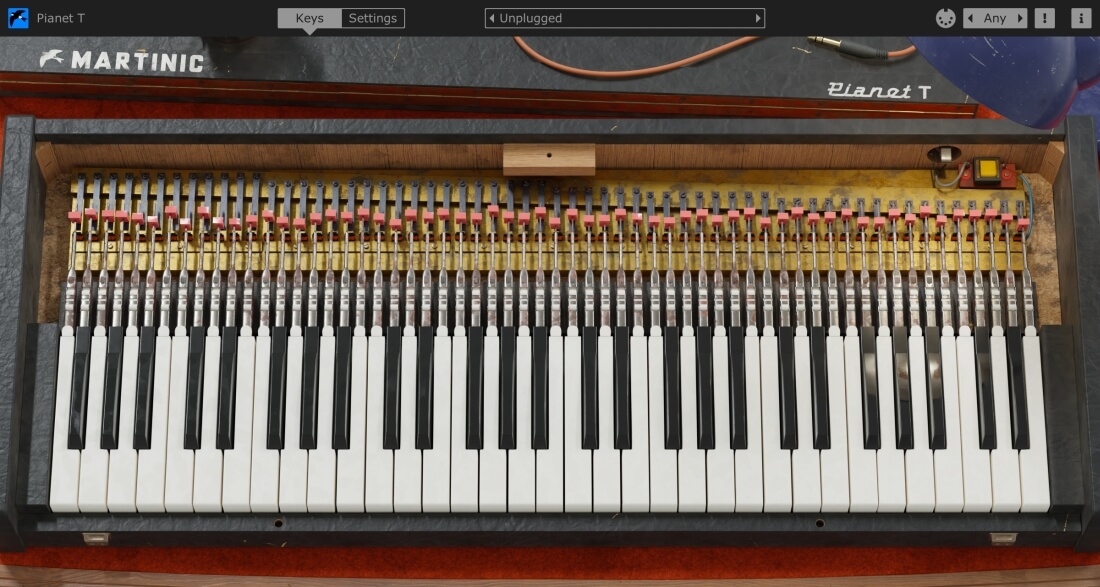
The Keys view on the "Unplugged" preset: the lid is open, showing the row of steel reeds with the pink suction pads above the 60 keys.
Features
Pickups and Unplugged, mixed
Martinic Pianet T has two sound sources: the modeled electromagnetic pickups and a physically modeled Unplugged sound of the reeds themselves. A two-channel mixer gives each one pan, width, room and volume, so you can play the classic amplified sound, the intimate unamplified one, or a blend.
Harmonic Mix
Martinic Pianet T's Harmonic Mix has six level controls that change the harmonic content of the pickup sound. Small moves give subtle tonal shifts; big ones can turn the Pianet T into something close to a vibraphone.
Vibrato, tremolo, chorus and a tube amp
Martinic Pianet T includes a vibrato and a Pianet N style tremolo, both with retrigger, delay and tempo sync from 16 bars to a 1/64 note, a digital chorus, and a vintage tube guitar amp with spring reverb and five speaker cabinet models. A room reverb adds natural space to either model.
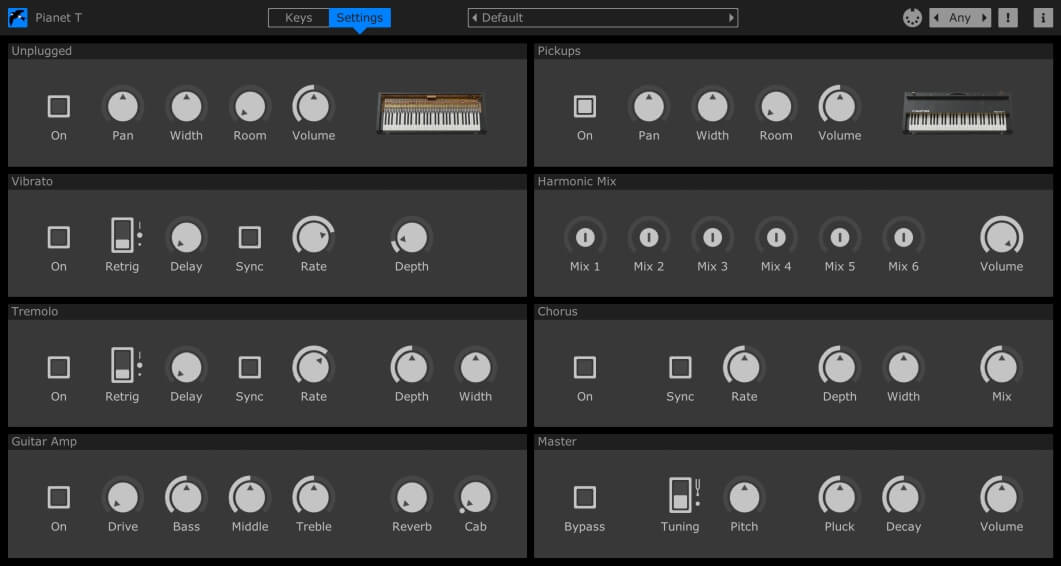
The Settings view: Unplugged and Pickups channels, vibrato, the six Harmonic Mix knobs, tremolo, chorus, guitar amp and master controls including tuning, pluck and decay.
Playing and tuning controls
Martinic Pianet T lets you choose vintage or equal temperament tuning, shift the global pitch by up to 100 cents, set the level of the mechanical pluck noise and the reed decay time, and use a volume pedal (MIDI CC#11 by default). The MIDI range extends to 73 notes (C1 to C7), with sustain pedal, pitch bend, program changes and MIDI learn on every control.
Benefits
- A keys sound most people don't already have: it isn't another Rhodes or Wurlitzer, so it stands out in a mix.
- Efficient: no sample library, a 16 MB installer, and a touring keyboardist quoted by Martinic calls it processor efficient.
- Wide tonal range: from dry, plucky 70s pop keys to a soft unplugged piano or a vibraphone-like tone.
- No activation hassles: a key file that works offline.
Real-World Uses
- Retro pop and new wave: the bright, percussive pickup sound through the tremolo.
- Lo-fi and bedroom pop: the Unplugged model with room and a little chorus for a soft, close sound.
- Jazz and soul keys: the tube amp with light drive and spring reverb.
- Songwriting: a distinctive keys part to start an idea, as singer-songwriter Laura White describes.
Who It's For, and Who Should Skip It
It's for keyboard players and producers who want a vintage electric piano that's different from the usual Rhodes and Wurlitzer, and anyone who likes 60s and 70s pop keys.
Skip it if you need a full-range piano (it plays 73 notes at most), a classic Rhodes or Wurlitzer tone specifically (dedicated emulations of those fit better), or a standalone app for playing without a DAW or plugin host.
Usage Guide
- Download the installer for your system from the downloads page: Windows x64/x86, Windows Arm64EC or the macOS DMG.
- Install the formats you need (AAX, CLAP, VST2, VST3, plus AU on Mac).
- Rescan plugins in your DAW and load Pianet T on an instrument track. Unlicensed, it runs as the demo with white noise.
- After buying, put the license key file you receive next to the installer and run the installer again to install it.
- Start from a preset, then use Settings to balance Pickups against Unplugged and shape the tone with the Harmonic Mix.
- Add tremolo or the amp, and map the volume pedal to an expression pedal if you have one.
Before you buy
- Time the sale. Martinic's Black Friday sale (50% off all plugins) runs from November 19 to December 5, 2026. Afterwards the lifetime license returns to $99.
- Consider Retro Pack 2. It bundles Pianet T with Elka Panther, Scanner Vibrato, Colorsound Tremolo, Lem Echo Music and the free Kee Bass for $239 ($119.50 in the sale).
- Free updates stop at version 2. A license includes free upgrades through version 1.x.x only.
- Refunds go through FastSpring, Martinic's payment provider, so try the demo first.
Where it falls short
- Few independent reviews. There's one user review on KVR, written as a first impression, and news coverage rather than a full magazine review.
- Only 32 presets. Fine for one instrument, but much smaller than synth libraries; expect to make your own.
- Limited range. The original has 60 keys; the plugin extends to 73 notes, not a full 88.
- No standalone version. You need a DAW or plugin host.
What Users Say
Gearnews (Rob Puricelli, May 2024)
Gearnews covered the launch: "Put simply, the Martinic Pianet T delivers one of the most complete Pianet T experiences outside the real deal, and goes some way beyond it too!" On the interface: "switching to the Settings page delivers a clean, simple interface that gives you control over every detail of the model."
KVR Audio (5 out of 5 from 1 review)
- tommyzai (v1.0, Mac, May 2024), in what he calls "a first impression, not a full-blown review": "The sound pallet seems to fall between a Wurlitzer and Rhodes—so warm and fat, but there's a nice tine-clarity at the same time. This is sure to be a winner. It's got a solid, usable sound. Its charm is not FX-dependent."
Musicians quoted by Martinic
- Henry Hey (Forq and Rudder): "This plugin sounds incredible! It has a ton of sound shaping options and even more importantly it is processor efficient. It's exactly what I was looking for!"
- Solidtrax, who own a Hohner Pianet T: "As owners of the Hohner® Pianet T and having experienced the magic firsthand, we can confidently say that Martinic has truly captured its essence."
- Lic. Ezequiel Morfi (TITANIO): "This rendition of the classic Hohner® Pianet T by Martinic sounds exactly like the hardware unit we have in the studio but also takes that beautiful instrument far beyond!"
- Andrew Macaulay: "Loving the sound - it is certainly different from the Rhodes and Wurlitzer sounds that are available from others."
- Laura White: "The sounds are so experimental too making new song ideas easy to start and get creating!"
The pattern: people who own the hardware say it sounds like the real thing, and players like that it's different from a Rhodes or Wurlitzer and light on CPU. Independent criticism is scarce, so the demo is the best test.
Comparisons
Pianet T vs a Rhodes or Wurlitzer plugin
A Rhodes uses struck tines for a round, bell-like sustain, and a Wurlitzer uses struck reeds for a barkier tone. The Pianet T's plucked reeds give a shorter, more percussive note that sits between the two. If you already have both of those, Pianet T adds a third color rather than replacing either.
Pianet T alone vs Retro Pack 2
Pianet T is $99 ($49.50 in the sale). Retro Pack 2 adds Elka Panther, Scanner Vibrato, Colorsound Tremolo and Lem Echo Music for $239 ($119.50 in the sale); the Colorsound Tremolo in particular suits electric piano. If you'd use two or more of those, the pack is the better buy.
Editions and Pricing
| Option | Regular price | Price to Dec 5, 2026 | What you get |
|---|
| Full Version | $99 | $49.50 | Lifetime license, updates through 1.x.x |
| One Year License | $33 | $33 | Full plugin for 12 months, no auto-renewal |
| 3-Month Trial Plus | $19 | $19 | Full plugin for 3 months, no auto-renewal |
| Retro Pack 2 | $239 | $119.50 | Pianet T plus five more Martinic instruments and effects |
The Pianet T licenses are on the same order page; the Buy Now button takes you there.
FAQs
Does Martinic Pianet T use samples?
No. Martinic Pianet T models the pickups with Martinic's ACE technique and the acoustic sound with a physical model, which keeps the Windows installer to about 16 MB.
Does Martinic Pianet T need an iLok or online activation?
No. Martinic Pianet T uses a license key file from FastSpring, with no dongle and no online activation.
Does Martinic Pianet T run on Apple Silicon and Windows on Arm?
Yes. Martinic Pianet T runs natively on Apple Silicon and Intel Macs, and there's an Arm64EC build for Windows 11 on Arm (CLAP, VST2 and VST3).
How many keys does Martinic Pianet T play?
Martinic Pianet T shows the original 60-key, five-octave F-to-E keyboard and responds to an extended MIDI range of 73 notes, from C1 to C7.
Does Martinic Pianet T respond to velocity and the sustain pedal?
Yes. Martinic Pianet T has a full velocity range and supports the sustain pedal (CC#64), pitch bend of two semitones and MIDI program changes.
What is the 3-Month Trial Plus license?
Martinic Pianet T's 3-Month Trial Plus is a $19 license that gives you the full plugin, without the demo noise, for three months and doesn't renew. It suits a single project; the free demo is enough to judge the sound.
System Requirements
- Windows 7 or newer, x64 or x86 (AAX, CLAP, VST2, VST3)
- Windows 11 on Arm via the Arm64EC installer (CLAP, VST2, VST3)
- macOS 10.9 Mavericks or newer, Intel or Apple Silicon (AAX, AU, CLAP, VST2, VST3)
- A DAW or plugin host; a sample rate of 44.1 kHz or higher is recommended
Conclusion
Martinic Pianet T is worth buying if you want a vintage electric piano with a different voice from the usual Rhodes and Wurlitzer: the Unplugged model and Harmonic Mix give it more range than the original, and it's light on CPU. At $49.50 until December 5, 2026 it's good value; at $99 it's fair for a specialist instrument. The main reason to pass is if you only need a classic Rhodes or Wurlitzer, or a full 88-note piano. Try the demo first.
Download Free TrialBuy Now