Martinic Prodigy: The 1979 Moog Prodigy as a Plugin, With a Sequencer and Polyphony Added
Martinic Prodigy is a $99 software synthesizer ($49.50 in Martinic's Black Friday sale until December 5, 2026) that models Moog's 1979 Prodigy monosynth for Windows and macOS in AAX, AU, CLAP, VST2 and VST3 formats. It keeps the original's two-oscillator, ladder-filter sound and adds a 16-step sequencer, 8-voice polyphony, 6-voice unison, a sub oscillator, noise, drive and spring reverb. A free demo is available.
The real Prodigy was Moog's budget monosynth: two oscillators, hard sync, glide and a filter with plenty of bite, loved for basses and leads. Good used units are getting scarce and expensive, and they don't save presets. Martinic's version gives you that sound in your DAW, with patch memory and a lot more range.
Quick facts
- Developer: Martinic (Schagen, The Netherlands)
- Version: 1.0.1, released September 23, 2026 (first release September 3, 2026)
- Modeled on: Moog Prodigy (1979), using Martinic's ACE circuit modeling
- Formats: AAX, AU (Mac), CLAP, VST2, VST3; no standalone app
- Platforms: Windows 7 or newer (x64/x86), Windows 11 on Arm (Arm64EC), macOS 10.9 or newer on Intel and Apple Silicon
- Installer size: 18.3 MB (Windows), 86 MB (Mac)
- Presets: 300+ factory presets
- Price: $99 lifetime license, $49.50 until December 5, 2026; One Year License $33; Prodigy Bundle with four preset collections $149 ($74.50 in the sale)
- Copy protection: a license key file; no dongle and no online activation
- Demo: free and fully featured, but adds white noise to the output; for testing and unpublished work only
- What we checked: the US checkout prices ($99 list, 50% off to $49.50; Prodigy Bundle $149 to $74.50; One Year License $33) on Martinic's FastSpring store, the 18.3 MB Windows installer for version 1.0.1, and the changelog and specifications on martinic.com, on November 19, 2026. We didn't compare it with a hardware Prodigy.
Download Free TrialBuy Now
Overview
Martinic Prodigy has two faces. The Keys view is a photo-style copy of the original panel, with the same knobs and switches doing the same jobs: two oscillators with octave and waveform switches, sync, the Osc 2 interval knob, a mixer, the 24 dB per octave ladder low-pass filter with emphasis and keyboard tracking, and separate filter and loudness contours. A Settings view holds everything Martinic added, and a Presets view handles the library.
The additions are substantial. Both oscillators get variable pulse width, Osc 1 gains a Minimoog-style shark's-tooth wave and Osc 2 a ramp, and there's a sub oscillator, pink and white noise, filter drive, a mono spring reverb modeled after the Moog 905, full ADSR envelopes, an expanded LFO, 6-voice unison and an 8-voice polyphonic mode. A step sequencer runs either as one 16-step chain or two parallel 8-step chains.
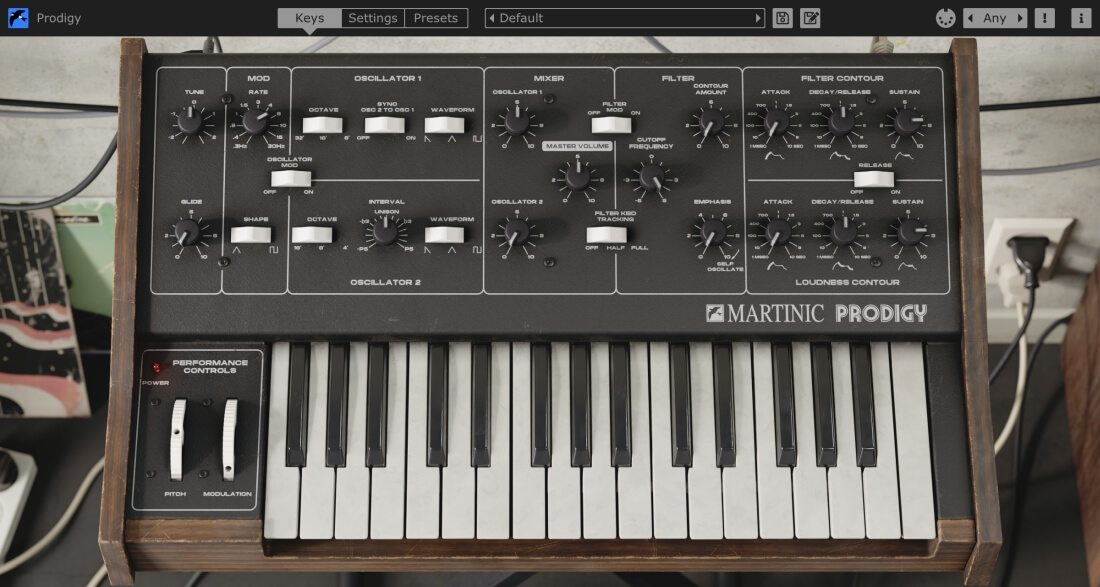
The Keys view: the Prodigy's panel with modulation, two oscillators, mixer, filter and the filter and loudness contours, over a 32-key keyboard with pitch and mod wheels.
Features
The original Prodigy signal path
Martinic Prodigy recreates the 1979 circuit: two VCOs with three footages and three waveforms, hard sync of Osc 2 to Osc 1, an interval control, variable glide, a modulation section with two wave shapes from 0.26 to 31 Hz, the 24 dB per octave ladder filter and attack, decay/release and sustain contours with a release switch. As on the original, the mod wheel bends only Osc 2 when sync is on, which is where the classic sync sweeps come from.
More oscillator and filter options
Martinic Prodigy adds a fourth waveform per oscillator, adjustable pulse width with modulation, per-oscillator modulation depth, a square-wave sub oscillator, a pink/white noise generator, filter drive and an emphasis boost. Synth Anatomy singled out the added bass compensation, which keeps the low end from thinning out as you raise the filter's emphasis.
Mono, unison or 8-voice polyphony
Martinic Prodigy plays as a monosynth with selectable note priority and legato or gated glide, as a 6-voice unison stack with detune and stereo spread, or as an 8-voice polysynth, something Moog never offered on the Prodigy. Velocity response, an extended 128-note range, master pan and width complete the performance section.
A built-in 16-step sequencer
Martinic Prodigy's sequencer runs 16 steps in series or two 8-step chains in parallel, in loop, one-shot or single-step mode, with tempo sync and retrigger. Each step has a level and a trigger, and the level can drive oscillator pitch (with optional quantize), the filter, pulse width, mix, volume or pan, with glide between steps. It turns the synth into a self-contained bassline and pattern machine.
MPE, MIDI learn and presets
Martinic Prodigy supports MPE pitch bend (glide), MIDI learn on every control, program changes, sustain pedal and volume pedal. Version 1.0.1 added a Modern Pitch Bend range switch. It ships with 300+ presets from sound designers including Daniel Stawczyk, Solidtrax, Johnny Rohrbeck and Doctor Mix.
Benefits
- The Prodigy sound without the hardware risks: no tuning drift, no aging components, and patches you can save and recall.
- More than a museum piece: polyphony, the sequencer and modern modulation make it useful well beyond basses and leads.
- Quick to learn: the Keys view works exactly like a simple 70s monosynth, so beginners can learn subtractive synthesis on it.
- Affordable: $99, or $49.50 in the sale, for a lifetime license with no activation.
Real-World Uses
- Techno and electro basslines: program a 16-step pattern with filter steps and let it run in sync with the DAW.
- Sync leads for synth-pop and new wave: hard sync plus the mod wheel on Osc 2 for the classic tearing sweep.
- Thick unison stabs: six detuned voices spread in stereo for rave and trance stabs.
- Simple poly pads and chords: 8-voice mode with the spring reverb for warm, vintage-flavored chords.
Who It's For, and Who Should Skip It
It's for producers who want a raw Moog-style mono bass and lead synth with a built-in sequencer, and for anyone who wanted a Prodigy but not the price or upkeep of a 1979 instrument.
Skip it if you need a standalone app, a large rendered interface (the KVR reviewer below found the UI either too small or too big), or a full Minimoog with three oscillators and more routing: a Minimoog emulation is the better fit there. If you already own a good Minimoog-style plugin and mostly want basses, the Prodigy's extra value is mainly the sequencer.
Usage Guide
- Download the installer for your system from the downloads page: Windows x64/x86, Windows Arm64EC or the macOS DMG.
- Run it, choose the plugin formats, and on Windows pick a GUI size; the interface size is set during installation.
- Load Martinic Prodigy in your DAW. Without a license it runs as the demo, with white noise in the output.
- After buying, copy the license key file you receive next to the installer and run the installer again to install it.
- Start from a preset, then shape it on the Keys view; open Settings for the sequencer, voice modes, drive and reverb.
- Assign hardware knobs with MIDI learn and save your sounds as user presets.
Before you buy
- The sale ends December 5, 2026. Martinic's Black Friday sale cuts all plugins by 50% from November 19 to December 5, 2026; after that the license is back to $99.
- Bundle or not. The Prodigy Bundle adds four Prodigy Sounds preset collections for $50 more at list price ($25 more in the sale).
- It's a young product. Version 1.0 came out in September 2026, so expect fixes and additions through 1.x, which a license includes for free.
- Refunds go through FastSpring, Martinic's payment provider, so try the demo first.
Where it falls short
- Audible stepping on sync sweeps. Sound On Sound's reviewer heard stepping when sweeping synced sounds, unlike the analog original.
- A confusing Drive knob. The drive sits with the mixer on the Settings page, but it acts after the filter, not before it.
- Interface size. The photo panel looks washed out to one KVR reviewer, and the GUI is fixed at the size picked in the installer.
- No standalone version, as with all Martinic instruments.
What Users Say
Martinic Prodigy came out in September 2026, so there are only a few reviews so far.
Sound On Sound (Gordon Reid, October 2026 issue)
Gordon Reid tested a pre-release version next to his own Prodigy, using a controller with the same 32-note keyboard.
- On the oscillators: "The sawtooth, triangle and square waves were similar across all ranges and I wasn't concerned by the small differences that I encountered"
- On sync: "you can hear stepping as you sweep sync'ed sounds. It's not awful, but it's not the same as the analogue synth."
- On the Drive knob: "this is placed in a misleading position in the Settings page because the overdrive affects the signal after it has passed through the filter, not before it."
- On formats: "the soft synth is supplied in a range of plug‑in formats but not as a standalone application."
Synth Anatomy (September 3, 2026)
- On the sound: "I can't say how authentic the Prodigy emulation is since I don't own any original hardware. But based on my past in-person experiences with a Prodigy and YouTube demos, the Martinic plugin has a sonic character that goes strongly in that direction."
- On the additions: "The additional features make sense, and with up to 8 voices, it's now a Prodigy polyphonic synth that Moog never built."
- On the filter: "thanks to the added bass compensation, which should be mandatory in every new ladder filter-based synth."
KVR Audio users (3 out of 5 from 1 review)
mhorrocks (v1.0, Mac, September 4, 2026): "Sounds great but the poor UI lets it down badly. Users like to feel they're getting the real experience but the photo UI is rather washed-out looking, and either too small at 100% or ridiculously big at 200%. You also have to set the UI size when installing the plugin, which seems almost like a real 70's computer experience, lol!"
The pattern: reviewers agree the sound is close to the original and like the added polyphony, filter compensation and sequencer. The complaints are about the interface (its look and fixed size), some stepping on sync sweeps, and the lack of a standalone version.
Comparisons
Martinic Prodigy vs the original Moog Prodigy
The hardware is a 32-key monosynth with two oscillators, a single LFO, two ADS contours and no memory. The plugin keeps that panel and adds pulse width control, a sub oscillator, noise, drive, reverb, full ADSRs, polyphony, unison, the sequencer, MPE and presets. Purists may hear differences in sync sweeps, according to Sound On Sound.
Martinic Prodigy vs Martinic AX73
The AX73 ($149) is a two-layer polysynth built for pads, keys and layered 80s sounds. The Prodigy ($99) is at heart a mono bass and lead synth with a sequencer. If you mainly write basslines and leads, pick the Prodigy; for pads and splits, the AX73.
Editions and Pricing
| Option | Regular price | Price to Dec 5, 2026 | What you get |
|---|
| Full Version | $99 | $49.50 | Lifetime license, updates through 1.x.x, 300+ presets |
| One Year License | $33 | $33 | Full plugin for 12 months, no auto-renewal |
| Prodigy Bundle | $149 | $74.50 | Prodigy plus four Prodigy Sounds preset collections |
All three are offered on the Prodigy page that the Buy Now button opens.
FAQs
Is Martinic Prodigy monophonic like the original?
Martinic Prodigy can be. It has a mono mode with note priority and glide like the original, plus a 6-voice unison mode and an 8-voice polyphonic mode the hardware never had.
Does Martinic Prodigy need online activation or an iLok?
No. Martinic Prodigy uses a license key file generated by FastSpring when you buy, with no dongle and no online activation, so it works on offline studio computers.
Does Martinic Prodigy support MPE controllers?
Yes, partly. Martinic Prodigy supports MPE pitch bend (glide), and Sound On Sound lists glide, velocity, aftertouch and key repeat among the MPE functions it handles.
Does Martinic Prodigy run on Apple Silicon and Windows on Arm?
Yes. Martinic Prodigy's Mac installer runs natively on Intel and Apple Silicon, and a separate Arm64EC installer covers Windows 11 on Arm (CLAP, VST2 and VST3).
Can I change Martinic Prodigy's window size later?
Martinic Prodigy's GUI scale is chosen when you run the installer (up to 200%). To change it, run the installer again with a different setting.
What's in the Prodigy Bundle?
The Prodigy Bundle is a full Martinic Prodigy license plus four hand-picked Prodigy Sounds preset collections, with free updates through version 1.x.x for the synth and all four collections.
System Requirements
- Windows 7 or newer, x64 or x86 (AAX, CLAP, VST2, VST3)
- Windows 11 on Arm via the Arm64EC installer (CLAP, VST2, VST3)
- macOS 10.9 Mavericks or newer, Intel or Apple Silicon (AAX, AU, CLAP, VST2, VST3)
- A DAW or plugin host; a sample rate of 44.1 kHz or higher is recommended
Conclusion
Martinic Prodigy is worth it for anyone who wants a Moog-style mono bass and lead synth with real bite, and at $49.50 until December 5, 2026 it costs less than many sample packs; even at $99 it's fair. The one reason to buy it is the combination of the Prodigy sound with a proper sequencer and polyphony. The main reason to hesitate is the interface, which is fixed in size and looks dated to some users, so try the demo and see whether it suits your screen.
Download Free TrialBuy Now