RedmineUP Full Stack Bundle: Turn Redmine into Agile Boards, Helpdesk, CRM and Billing in One Purchase
Redmine is a solid, free issue tracker, and plenty of teams outgrow its core within a year. Developers want a drag-and-drop board instead of a long issue list. Support wants customer emails to turn into tickets. Sales wants to see which deals are open. Finance wants invoices built from the hours already logged. The usual answer is three or four separate SaaS tools and a lot of copying between them.
The RedmineUP Full Stack Plugins Bundle takes the other route: it adds all of that inside the Redmine you already run. It's every PRO plugin RedmineUP makes, in one license, installed on your own server, so your projects, customers, tickets and invoices live in one system that you control.
Quick facts
- What it is: all RedmineUP PRO plugins for Redmine in one pack (15 plugins on the current list)
- Developer: RedmineUP (Nideni LLC)
- Runs on: your own Redmine 5.0 to 7.0 server, with Ruby 3.1 to 4.0, on Linux, macOS or Windows
- Databases: SQLite, MySQL, PostgreSQL or SQL Server
- Price: $1,799 USD for a single-server license. The multi-server license costs $4,799.
- Bought separately: RedmineUP puts the plugins at $3,436 if bought one by one
- License: use the plugins for a lifetime, with 12 months of updates and technical support included. Renewal is optional.
- Try first: no trial download for the bundle, but RedmineUP sends a link to a fully functional demo on request, and several plugins have free Light editions
Before you buy: this is for self-hosted Redmine
These are plugins, not a standalone program. You need your own Redmine server (version 5.0 to 7.0 for current releases) and someone comfortable installing Redmine plugins, or you can pay RedmineUP for installation. If you'd rather not run a server at all, RedmineUP sells a hosted Redmine with the plugins included as a separate product. Also note that updates and support last 12 months. After that the plugins keep working, but you'll need to renew to keep getting updates, which matters when you upgrade Redmine itself.
Overview
The bundle includes the PRO editions of Agile, Helpdesk, CRM, Invoices, Finance, Products, People, Checklists, Drive, Questions, Mailchimp, Zenedit, Reporter, Resources and Budgets. They're built to work together: a Helpdesk ticket shows the customer's CRM profile, an invoice can bill Redmine time entries, and Finance links payments to invoices. RedmineUP says over 150,000 companies in 120 countries use its plugins, themes and services, and the plugins are under active development, with regular updates for the latest Redmine releases.
Features
Agile: drag-and-drop Scrum and Kanban boards
The Agile plugin turns Redmine issues into a board you can work from. Drag cards between columns, comment and tick checklists right on the card, and create issues without leaving the board. It respects your Redmine workflow, so a card can't jump to a status it isn't allowed to reach. The PRO edition adds a sprint planner and backlog, story points, work-in-progress limits, sub-columns and swimlanes, saved boards by user, role or project, and card colors by priority, project or spent time.
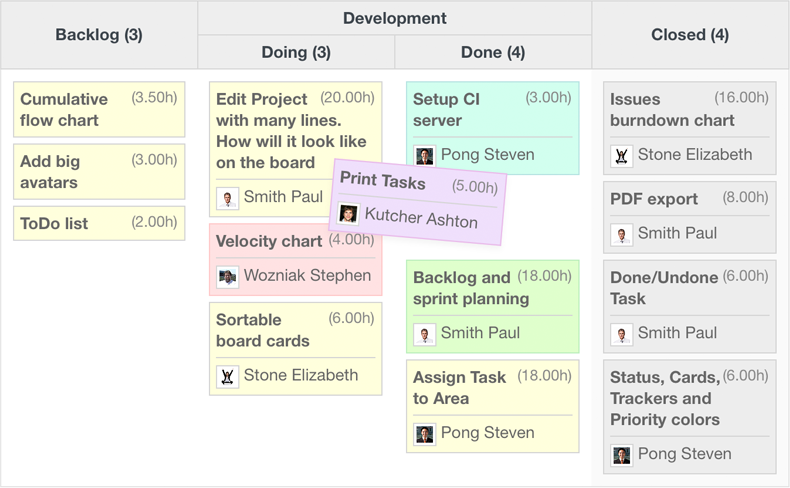
An Agile board with Backlog, a Development column split into Doing and Done, and Closed. Each card shows its estimate and assignee, and one is being dragged between columns.
Agile charts for sprint health
RedmineUP lists 11 Agile charts, including burn-down, burn-up, cumulative flow, velocity and lead time. They show at a glance whether a sprint will land, and the PRO edition lets you save charts for reuse.
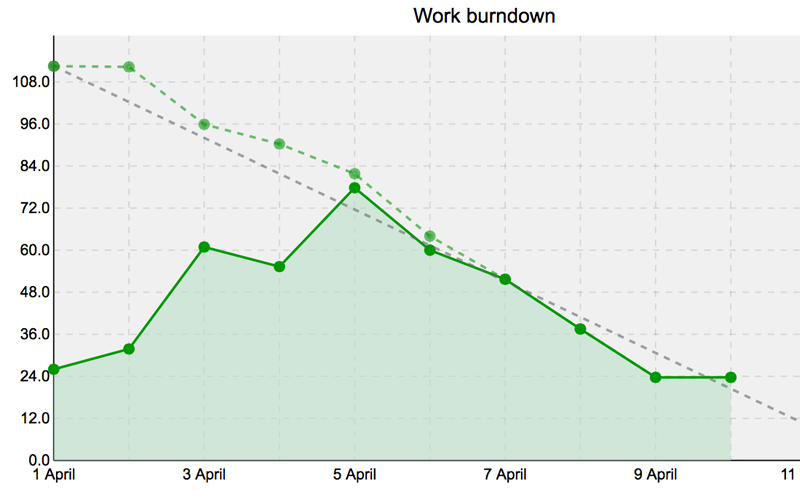
A work burndown chart plotting remaining work against the ideal line over a sprint.
Helpdesk: customer email becomes tickets
Helpdesk pulls customer messages in over POP3 or IMAP and turns them into Redmine issues you can answer straight from the issue page. You get autoresponders, canned replies and templates with macros, CC and BCC lists, rules that sort incoming mail automatically (for example, marking anything with "Urgent" in the subject as high priority), an embeddable widget with a REST API for your website, SLA metrics such as first response time, and satisfaction ratings your customers leave with one click.
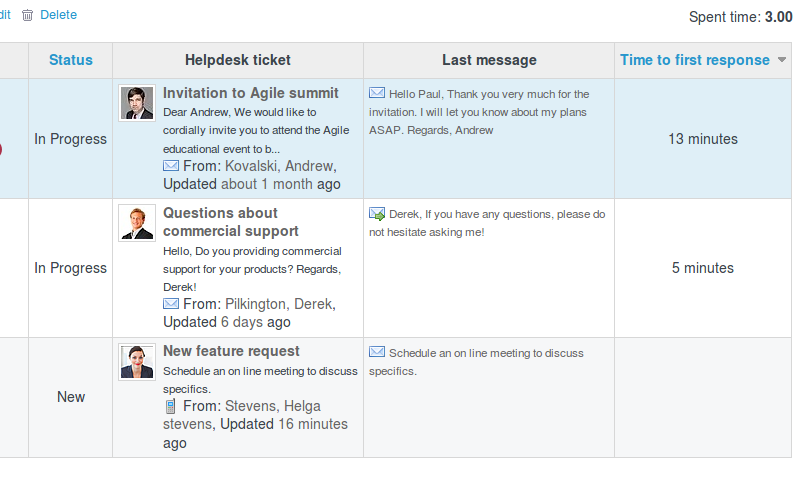
Helpdesk tickets in the Redmine issue list, with each customer's photo, the last message and the time to first response.
CRM: contacts, companies and a sales funnel
CRM stores people and companies with notes, files and tags, and shows each contact's related issues, tickets and orders. The PRO edition adds deals with a custom sales funnel and success probability, a deals Kanban board, email sending from Redmine, custom fields, bulk edits and vCard export.
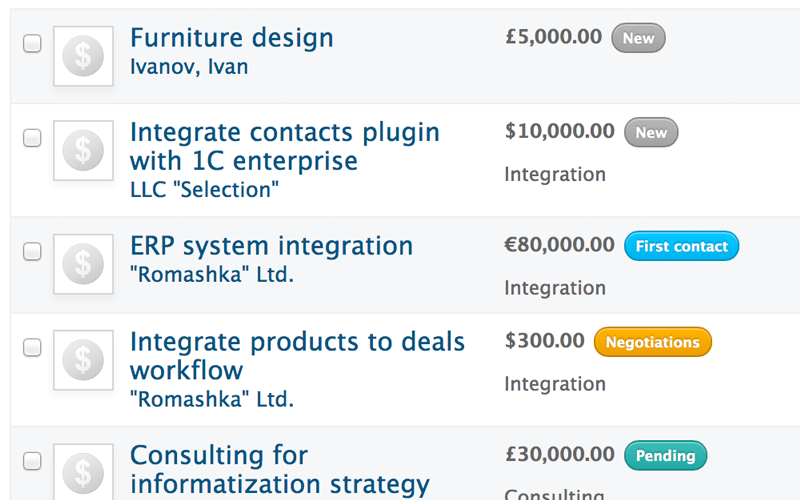
CRM deals with amounts in pounds, dollars and euros, the client company, and statuses such as New, First contact, Negotiations and Pending.
Invoices and Finance: bill the hours you already track
Invoices creates invoices, quotes and estimates, bills Redmine time entries with custom rates, tracks expenses, handles multiple currencies, taxes and discounts, and produces PDFs in 19 languages from built-in or custom templates. PRO adds recurring invoices, email sending, a client-facing public link and a PayPal button. Finance tracks income and expenses across accounts and links them to invoices.
The rest of the stack
- Resources and Budgets: plan team workload across projects, and set project and issue budgets with cost and bill rates.
- People: staff profiles, departments, permissions and birthday reminders.
- Products: a product and service catalog with orders, linked to deals and invoices.
- Checklists: to-do lists inside issues.
- Drive: file storage with client access.
- Questions: Q&A boards, a knowledge base and idea pages.
- Mailchimp: manage CRM contacts as Mailchimp subscribers.
- Zenedit: user and issue mentions, saved drafts and full-screen editing.
- Reporter: printable issue reports with time entries and notes.
Benefits
The obvious win is price. Buying the plugins one by one costs about twice as much as the bundle, and the bundle costs less than the Agile and Helpdesk multi-server licenses combined.
The bigger win is one system. When the support ticket, the customer record, the developer's task and the invoice all live in Redmine, nobody has to copy information between tools, and everyone sees the same history.
And because it's self-hosted, your customer data stays on your server. That matters for companies with privacy rules, or for anyone who'd rather not pay per user, per month, forever.
Real-World Uses
- A software house plans sprints on the Agile board, logs time against issues, and turns that time into client invoices at month's end.
- A product company routes support email through Helpdesk, sees each customer's CRM profile and past tickets beside the issue, and tracks first-response times.
- A digital agency tracks leads as CRM deals, moves won deals into projects, and uses Resources to see who's overbooked next week.
- An internal IT team runs a Questions knowledge base and Helpdesk for staff requests, with Checklists for repeatable onboarding tasks.
Who It's For
The Full Stack bundle fits organizations that already run Redmine, or plan to, and need more than one or two plugins. Once you need roughly three of them, the bundle is usually the cheaper route. It's not for teams without anyone to maintain a server, or for a small team that only needs a Kanban board. In those cases the single Agile plugin, or RedmineUP's hosted service, makes more sense.
Usage Guide
- Check compatibility. Look up your Redmine version (5.0 to 7.0) and Ruby version (3.1 to 4.0).
- Order and choose a license. Pick single-server (one production installation) or multi-server (unlimited installations within one company). You can enter a discount code and turn on auto-renewal during checkout.
- Download the plugins. A minute after payment, RedmineUP emails a link to the plugin files. Later updates come from the License Manager, reached through a link RedmineUP emails you on request.
- Install them on Redmine. Follow RedmineUP's installation documentation, or order their paid installation service.
- Enable per project. Turn on the modules each project needs and set permissions by role.
- Configure. Set up board columns, Helpdesk mailboxes and templates, CRM fields and invoice templates.
Tips
- Use the free test installations. A single-server license allows one production server, but developers can install the plugins on any number of local and test machines.
- Renew on time. The first renewal made before your license expires includes a renewal discount, and auto-renewal prices include a discount too.
- Ask for the demo before buying. RedmineUP emails a link to a fully working demo.
What Users Say
RedmineUP is rated 4.4 out of 5 on Capterra from 18 reviews. These excerpts were read through a summarizer, so treat the wording as close but not guaranteed exact.
Louis C., VP of Product, 5/5, "Quality plugins that make software design/development and support easier": "Their plugins are easy to initially install and update, while providing advanced features unavailable in the Redmine Core." His con: "Updates (new features) to plugins could come more frequently."
Mark C., Solutions Architect, 5/5, on the Agile plugin: "Licensing is a little expensive but this does not detract from the excellent product."
Kobus P., Android Team Lead, 4/5, "Good plugin. Just very expensive for a small team": "The price is very expensive for a small team."
Grzegorz L., Publisher Services Manager, 5/5, on Helpdesk, noted one downside: "Only one - in self-hosted requires Redmine installed."
On RedmineUP's own Helpdesk page, Gerhard Gappmeier, Executive Director Software Architecture & Development at ascolab GmbH, explains why his team chose it: "Before Helpdesk, we tried Jira, Zendesk, Freshdesk, OTRS, and Zammad. Zendesk does not support local installation. Hosted storage has privacy issues or is very expensive with control of your data. All other systems also had other issues. So we decided to use the Helpdesk plugin. Why? The price/functionality ratio is great, and the support gives fast responses with real solutions."
Comparisons
Full Stack vs. smaller bundles
RedmineUP also sells a CRM + Helpdesk bundle ($1,699) and a CRM + Helpdesk + Invoices bundle ($2,199). If you need the Agile board as well as client-facing tools, Full Stack covers everything for less.
Single-server vs. multi-server
Single-server ($1,799) allows one production Redmine. Multi-server ($4,799) allows unlimited installations within one company. Each additional company needs its own license either way.
Self-hosted plugins vs. RedmineUP Cloud
This bundle runs on your own server. RedmineUP Cloud is a separate hosted service with the plugins pre-installed and maintained for you, billed as a subscription.
Editions and Pricing
The license sold here is the single-server Full Stack bundle at $1,799 USD. It includes lifetime use of all the PRO plugins and 12 months of updates and technical support. Renewing afterwards is optional. At checkout it was listed at $1,259.30 for the next 12 months, and you can choose automatic or manual renewal. A multi-server version is available for $4,799.
FAQs
What happens when the 12 months of updates end?
The plugins keep working for as long as you like. You just stop receiving updates and technical support until you renew, which can matter when you upgrade Redmine itself.
Can I install it on a test server too?
Yes. A single-server license covers one production installation, but you can run as many testing and evaluation installations as you need, including developers' local machines.
Does it work with my Redmine version?
Current releases support Redmine 5.0 through 7.0 and Ruby 3.1 through 4.0. The Mailchimp plugin also supports Redmine 4.0. If you're on an older Redmine, upgrade first or ask RedmineUP which plugin versions fit.
Which databases are supported?
SQLite, MySQL, PostgreSQL and SQL Server, on Linux, macOS or Windows servers.
Is there a way to try it?
There's no trial download of the bundle, but RedmineUP emails a link to a fully functional demo, and plugins such as Agile, CRM and Invoices have free Light editions you can install.
Can I pay in my own currency?
Yes. Orders go through 2Checkout, which supports over 100 currencies, and EU companies can enter a VAT ID.
Do I get the plugins RedmineUP adds later?
The bundle is sold as all RedmineUP PRO plugins in one pack, and its list has grown: older descriptions of it name 12 plugins, the current pricing page 15. Ask RedmineUP how a newly added plugin is handled for existing bundle owners.
System Requirements
- Redmine: 5.0 to 7.0
- Ruby: 3.1 to 4.0
- Database: SQLite, MySQL, PostgreSQL or SQL Server
- Server OS: Linux, macOS or Windows
- Browsers: Chrome, Safari, Firefox and Internet Explorer
Conclusion
The RedmineUP Full Stack bundle is the most economical way to turn Redmine into a complete work hub: Agile boards for developers, Helpdesk for support, CRM and invoicing for the business side, all sharing the same data on your own server. Reviewers praise the quality and integration and grumble about the price, which is exactly why the bundle exists.
If you're already running Redmine and find yourself shopping for three or more plugins, this is the one to buy. Ask for the demo, check your Redmine version, and you'll know quickly whether it fits.